
Akonkwa Ariane is 31 years old, a single mother and a refugee. After political instability in the Democratic Republic of Congo forced her family to flee, she crossed into Uganda and settled in Kyaka II Refugee Settlement in Kyegegwa District. For years, life there meant uncertainty, scarce work and the daily weight of providing for a young daughter with very little to lean on.
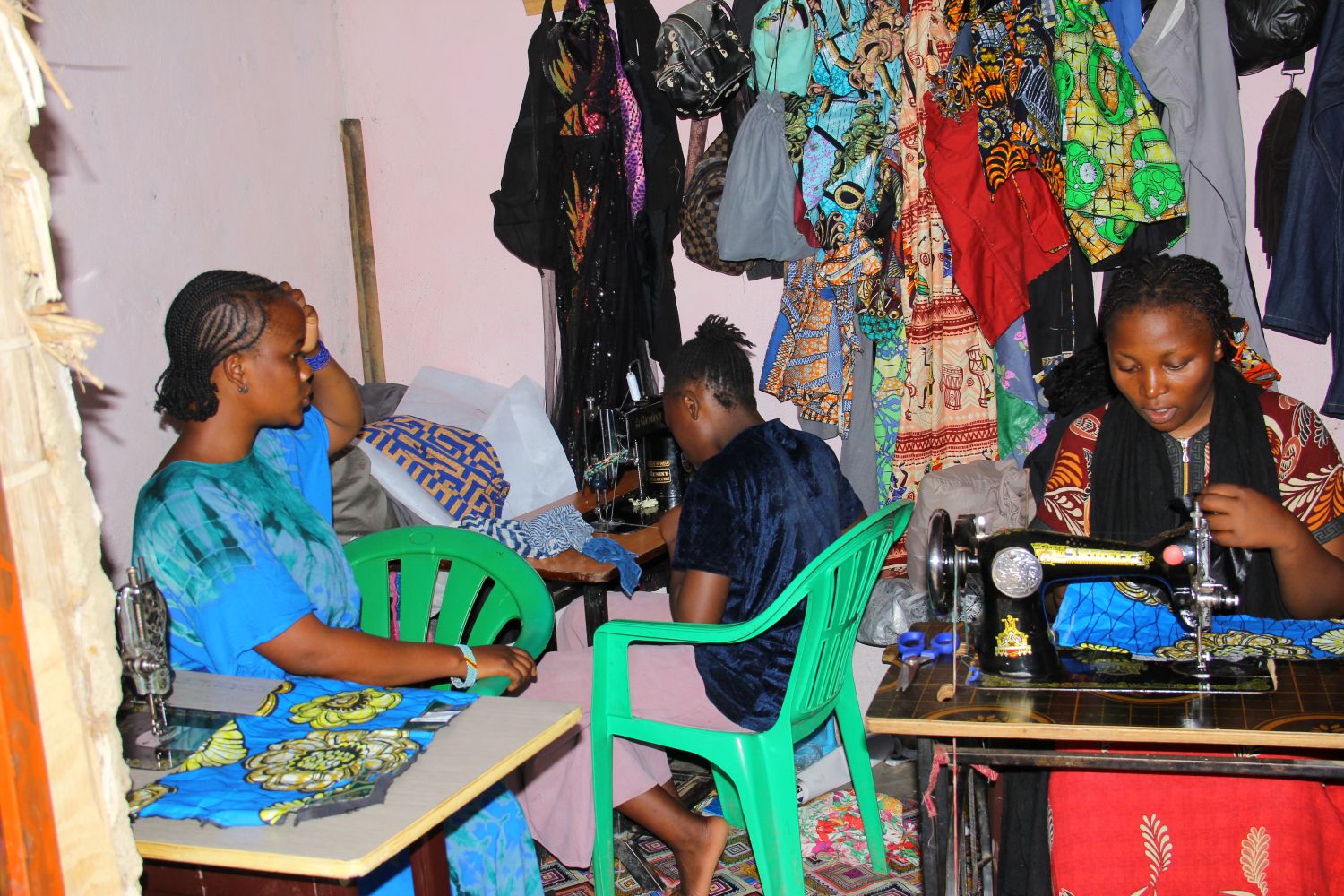
Today, Ariane runs a tailoring enterprise that earns her UGX 400,000 every month. She pays her daughter’s school fees, provides for her family and trains four other young women in the settlement. The change came through the Entrepreneurship and Skilling program at YIDA Youth Initiative, implemented under the Institutional Strengthening of YIDA project in partnership with the Mastercard Foundation. The program gave her business skills, and gave her a way to open doors for others.
Her passion waiting for an opportunity
Ariane has always carried a love for fashion. In the settlement, though, she had no resources, no work and no clear way to turn that passion into a living. Having arrived in Uganda with her family, she did not know what to do next.
That changed when she joined the Entrepreneurship and Skilling program at YIDA Youth Initiative. The program met her at a moment when she had the talent and the determination but not the structure, and it gave her the practical tools to start building a business around the skill she loved.
Barriers before joining the Entrepreneurship training.
Before joining the program, Ariane faced the challenges common to many refugee women entrepreneurs: limited income, little access to capital and a single mother’s constant pressure to meet her family’s needs. Her passion for fashion had nowhere to go.
Beyond these circumstances, she lacked the business know-how to turn a skill into a sustainable enterprise. She had no formal grounding in record keeping, in costing her products and services, or in drawing up a concrete business plan, and she had not yet developed the mindset of an entrepreneur. Without these, even a talented tailor struggles to price work properly, to know whether she is making money, or to plan for growth.
The Entrepreneurship and Skilling program combined practical skills training with business and mindset development. Ariane’s key learnings were developing a business plan that helped her in business management skills like record keeping, costing that are helping her to track income and expenses so she knows how her business is performing, how to organise and run a small enterprise day to day and how to cost her work so that prices cover expenses and leave a profit.
For Ariane, these were not minor adjustments. They turned a long-held love of fashion into a skill she could earn from.
Ariane’s business growth
Ariane now earns UGX 400,000 every month, an income she did not have before. She uses it to pay her daughter’s school fees and to provide for her family, which means more stability and more certainty for a single mother who once had very little to lean on.
Her enterprise has also become a training space. Ariane now mentors four young women inside the settlement, passing on the tailoring skills that reshaped her own life.
What defines Ariane is not only what she has built for herself, but who she carries with her. She actively seeks out the most vulnerable young women in her community, including single mothers, orphans and other vulnerable girls. She understands from experience what it costs to be overlooked, and what it means to be given a real chance.
Despite the financial strain of running a small enterprise, she provides her trainees’ meals and walks with them through every stage of their training. Two of her graduates have already launched their own businesses. She believes that even those who cannot start a business will find employment, because they carry the skill.
Ariane’s message to fellow young people
Ariane’s vision stretches further still. She wants to expand her training, reduce unemployment across the settlement and keep championing economic independence for women in the refugee community.
She is deeply grateful to YIDA Youth Initiative and the Mastercard Foundation. Her call to them is to keep reaching more young people, because they are the promise of the future.
Ariane’s story shows what happens when a young woman is given a real chance. The skills she received did not stop with her: she is passing them on to others, and every young woman she trains makes the settlement stronger.